
For decades, consumer brands were built around the shelf.
A product needed attractive packaging, good placement inside stores, distributor reach, retailer relationships and enough advertising to make people recognise the name. The formula was straightforward: create awareness, get into stores and wait for purchase habits to develop.
That formula still matters, but the shelf has changed.
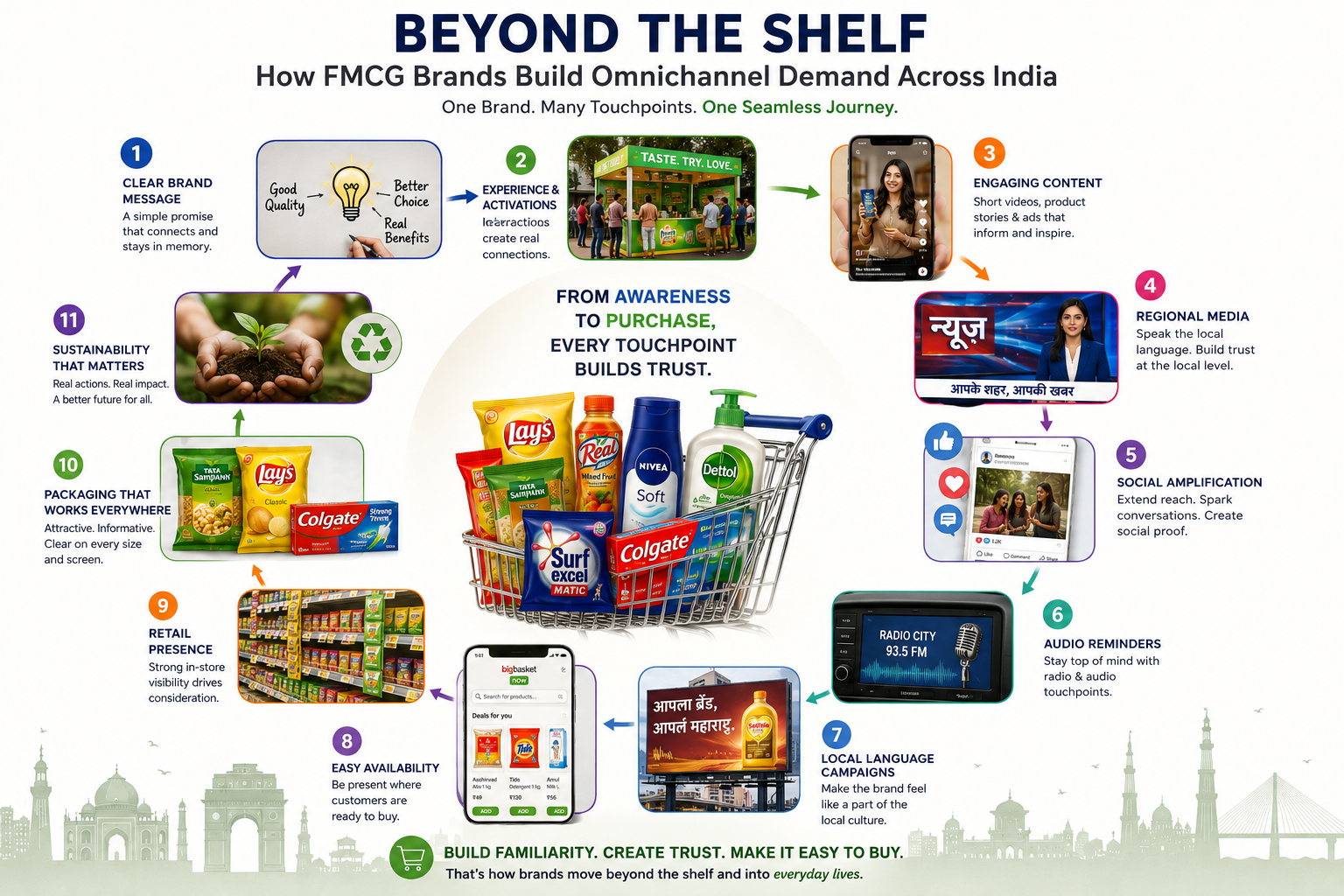
Today, a shopper may discover a product on Instagram, read about it through regional media, notice it during a local activation, search for it on Google, see it again on a connected television screen, compare it on a quick-commerce app and finally place an order from their phone.
The purchase may happen in seconds, but the decision is usually built over many earlier moments.
This is why modern FMCG marketing is no longer only about distribution. It is about creating a connected journey between visibility, memory, trust and availability.
A brand that appears only at the point of purchase is competing too late.
The brands that grow faster are the ones that start building familiarity before shoppers are actively looking. They create an identity that travels across packaging, digital content, regional language media, physical experiences, retail environments and marketplace listings.
The goal is not simply to make people see the product.
The goal is to make the product feel familiar enough to choose.
A Product Needs a Message Before It Needs More Reach
Many consumer brands spend heavily on awareness before defining what they want customers to remember.
They may have attractive packaging, a good logo, a clear category and even a useful product benefit. But if the brand cannot communicate one simple reason to choose it, every additional impression becomes less valuable.
A shopper should understand the core message quickly.
Is this a healthier alternative? A premium upgrade? A local favourite? A convenient everyday product? A product for families? A better ingredient story? A value-driven option? A modern version of something familiar?
The strongest brands do not try to say everything at once. They decide what single idea should stay with the customer after the advertisement, the store visit, the social-media post or the product-page view.
That is where thoughtful copywriting and creative direction becomes important. The right words do more than describe a product. They shape how the customer understands its place in daily life.
A snack brand may not be selling only flavour. It may be selling a better workday break. A skincare product may not be selling only ingredients. It may be selling confidence in a routine. A beverage brand may not be selling only refreshment. It may be selling energy, connection, celebration or comfort.
When the message is clear, every other part of the campaign becomes easier to build.
The visual language becomes sharper. The product videos become more focused. The retail display becomes more meaningful. The advertisement becomes easier to remember. The quick-commerce listing becomes easier to understand.
Without that clarity, even a high-budget campaign can feel like noise.
Trial Is Still One of the Most Powerful Forms of Marketing
Digital content can create awareness, but real experience can create conviction.
For consumer brands, especially food, beverage, personal care, beauty, wellness, household and lifestyle products, sampling and interaction remain powerful because they remove uncertainty. A person can touch the product, try it, compare it, ask questions and decide whether it fits into their routine.
This is why brand activations continue to matter.
A well-designed brand activation event can turn a product launch into something people actually participate in rather than simply observe. It can create a memorable moment in a mall, corporate park, college campus, residential community, retail location, exhibition, festival or high-footfall public space.
The difference between a simple promotion and a strong activation is participation.
A basic promotion says, “Here is our product.”
A good activation says, “Come experience why this product belongs in your life.”
That experience may involve tasting, testing, customisation, games, demonstrations, product education, influencer participation or on-ground storytelling. It creates an emotional connection that a banner or static post cannot always achieve.
More importantly, a physical activation can generate content.
A sampling moment can become a Reel. A customer reaction can become social proof. A founder interaction can become an interview. A pop-up can become a media story. A roadshow can create city-level visibility.
The brand no longer has to choose between on-ground marketing and digital marketing. The strongest activations are designed to do both.
The Product Must Look Good at Every Size
A product pack that looks premium in a physical store may not automatically look premium on a small mobile screen.
This matters because more consumer decisions are now happening through thumbnails, product cards, app listings, marketplace images and quick-commerce catalogues.
The shopper may have only a few seconds to understand the brand, product category, pack size, flavour, benefit and price.
The product needs to work visually at every level.
It should look convincing on a large retail display, inside an advertisement, in a social-media post, on a marketplace page and as a tiny image inside a mobile app.
This is where a strong 360-degree product animation can be valuable. Interactive or motion-led product visuals allow customers to inspect the product from multiple angles, understand packaging details and see variants in a more engaging way.
For consumer brands, this can be useful when launching a new product range, introducing multiple SKUs, showing pack-size options or preparing for e-commerce expansion. It can also help a brand create visual consistency before every physical product shoot is complete.
The product should not look like one thing in advertising and another thing inside a marketplace app.
Every visual should reinforce the same brand promise.
When a customer recognises the pack instantly, the path from interest to purchase becomes shorter.
Content Should Be Built for Testing, Not Only for Publishing
A consumer brand cannot rely on one beautiful launch video for an entire year.
The market changes too quickly. Offers change. Products evolve. Customers respond differently to different messages. A video that works for one audience may not work for another. A product benefit that appeals in Mumbai may need a different treatment in Ahmedabad, Indore, Pune or Lucknow.
This is why brands need a volume of useful creative assets.
A single campaign shoot should become more than one advertisement. It should produce product cutdowns, short-form videos, customer clips, offer-led edits, social-media content, retailer-facing material and retargeting creatives.
A structured ad creative editing approach helps turn one set of footage into many useful campaign assets that can be tested across platforms.
The best-performing consumer brands do not create content only because they need something to post.
They create content to learn.
Which opening line holds attention? Which product benefit creates curiosity? Which offer drives action? Which customer concern needs more explanation? Which version makes people click? Which message feels more relevant in a particular market?
The answer is rarely found in one creative.
It is found through multiple well-planned variations.
A good campaign does not assume what customers want to see. It gives the market several ways to respond.
Sustainability Has to Be More Than a Packaging Claim
Consumer brands increasingly speak about sustainability, responsible sourcing, reduced waste, recyclable packaging, local production, nutrition, community support and environmental responsibility.
These themes can matter deeply to customers. But they can also become empty if they are used only as marketing language.
People can sense the difference between a genuine commitment and a decorative claim.
A brand that wants to communicate sustainability should first ask what it is actually doing. Is it reducing material use? Supporting local suppliers? Improving sourcing practices? Reducing food waste? Supporting environmental restoration? Building more responsible packaging? Creating community partnerships?
The strongest sustainability stories are built around visible action.
The storytelling approach used in environmental and climate campaigns offers an important lesson for commercial brands as well. The message should not focus only on what the company wants credit for. It should focus on the issue, the progress being made and the real people or communities connected to the work.
A food brand that supports waste reduction should show the process. A beauty brand that works with responsible ingredients should explain the sourcing. A household brand that reduces plastic should make the change visible. A consumer company that supports community or environmental programs should communicate the work respectfully, with proof rather than exaggerated promises.
Purpose becomes valuable when it strengthens trust.
It becomes weak when it feels borrowed.
Regional Expansion Needs More Than a National Ad
India is not one consumer market.
The same product can create different reactions in Gujarat, Maharashtra, Telangana, Karnataka, Delhi NCR, Uttar Pradesh, West Bengal or Tamil Nadu. Language matters. Local media habits matter. Family structure matters. Price sensitivity matters. Retail behaviour matters. The role of festivals, community, food preferences and cultural context also matters.
A brand entering a new market should not simply duplicate the original campaign and change the voiceover.
It should ask how customers in that market discover products, what they trust, where they shop and what kind of message feels most relevant.
For Gujarat-focused expansion, a TV9 Gujarati advertising campaign can help brands explore regional communication through a language-first media environment. The product story may remain consistent, but the creative should feel closer to the audience.
A regional campaign is not about reducing the national brand into a translated version.
It is about allowing the brand to speak naturally in the market it wants to enter.
The strongest regional campaigns usually combine a clear national identity with local relevance. The packaging stays recognisable. The product promise stays consistent. But the language, examples, media placement, visuals and campaign moments reflect the world of the customer.
That is how a product starts feeling less like an outsider and more like a brand that understands the market.
Young Consumers Need a Different Kind of Familiarity
Younger audiences do not always respond to traditional advertising in the same way as earlier generations.
They are exposed to more content, more recommendations, more product reviews and more competing offers. They often discover brands through short-form video, creators, entertainment content, social conversation and peer influence before they see a conventional advertisement.
This does not mean traditional media no longer matters.
It means the context needs to feel right.
For campaigns targeting younger Marathi-speaking audiences, a Zee Yuva advertising plan can support a more youth-oriented communication environment. A product may be part of fashion, food culture, personal care, entertainment, mobility, lifestyle or everyday convenience, and the creative should reflect the way the audience sees itself.
The best youth campaigns are not always the loudest.
They are often the ones that understand the audience’s self-image.
They know whether the customer wants value, aspiration, convenience, social currency, comfort, discovery or a sense of belonging. They create messaging that feels like part of the audience’s world rather than an interruption from outside it.
When a consumer brand earns relevance with younger buyers, it can build habits that last longer than a single campaign.
Credibility Can Matter Even for Everyday Products
FMCG brands are often treated as simple purchase decisions.
But trust still matters.
People want to know whether a product is safe, reliable, useful, widely available and worth trying. They may be buying a low-cost item, but the brand still needs to feel credible enough to enter their home.
Regional news environments can support that credibility when the product launch, business story, expansion plan or local availability has a meaningful reason to be communicated.
For businesses building visibility in Gujarat, an ABP Asmita advertising approach can help create regional presence through a familiar news environment.
This can be useful for companies announcing a local expansion, entering a new distribution network, launching a consumer service, opening retail points, introducing a locally relevant product or communicating a large campaign.
The purpose is not to make every campaign feel serious.
It is to use the right context for the right message.
A snack launch may need energy and entertainment. A product-quality story may need proof. A community initiative may need trust. A regional expansion may need local visibility. A founder story may need a credible communication environment.
Different stages of growth need different kinds of attention.
Social Amplification Helps a Brand Stay in the Conversation
A campaign can lose momentum quickly if it only appears once.
A strong launch or regional media placement may create a burst of attention, but attention fades unless the brand continues the conversation.
This is where social amplification becomes important.
A social strategy should not simply repost the same campaign image across every platform. It should extend the original story. It should create new angles, short clips, customer reactions, product moments, influencer content, city-level updates and reminders that keep the brand visible in everyday feeds.
A structured social amplification package can help connect larger media or campaign moments with the digital conversations that continue afterwards.
For a consumer brand, this may mean turning a new launch into a series of short videos. It may mean building awareness around product availability in a particular city. It may mean supporting a retail activation with local content. It may mean using founder clips, product demos, reviews and customer stories to reinforce the same message over time.
The key is consistency.
People rarely buy because they saw a product once.
They buy because the brand keeps appearing in relevant ways until it becomes familiar.
Audio Still Has a Place in Everyday Brand Building
Not every product message needs to be seen.
Some of the strongest brand memories are built through sound.
A radio campaign, a recognisable voice, a local language jingle, a short offer announcement or an RJ mention can make a brand feel present in the daily routine of a city.
Radio continues to be useful because it reaches people while they are commuting, working, shopping, travelling or managing household routines. It can create frequency without depending entirely on screens.
For brands targeting Hindi-speaking markets, Hindi radio advertising can support city-level familiarity across local audiences.
This can be especially useful when the product is widely available, when the message is simple and when the goal is repeated recognition. A food product, home-care brand, retail chain, wellness product, local service, seasonal offer or new market launch can all benefit from audio-led frequency when the creative is memorable.
The power of radio is not usually one dramatic moment.
It is repetition.
A customer may hear the name during a commute, notice the product later online and recognise it again in a store or quick-commerce app. That repeated exposure creates an easier path to trial.
Maharashtra Requires Both Scale and Specificity
Maharashtra is a major market for consumer brands, but it should never be treated as one uniform audience.
Mumbai, Pune, Nagpur, Nashik, Kolhapur, Thane, Navi Mumbai, Chhatrapati Sambhajinagar and other cities have different retail patterns, income levels, cultural references and media habits.
A statewide campaign can create broad awareness, but it still needs relevance for the households that will actually buy the product.
For FMCG companies, FMCG advertising on Zee Marathi can help support household-level visibility through Marathi language media and entertainment environments.
The value of regional-language communication is not only reach.
It is familiarity.
A customer who sees a brand communicating naturally in Marathi may feel that the product understands their home, their routines and their culture. That emotional proximity can matter when multiple products are competing in the same category.
The creative should be adapted, not simply translated.
It should sound natural. It should use the right tone. It should feel designed for the audience rather than copied from a national campaign.
When a brand gets that right, Maharashtra can become more than a large market.
It can become a loyal one.
The Final Test Is Whether the Product Can Be Bought Easily
Every campaign eventually reaches a moment of truth.
The customer sees the product, remembers the message and decides to buy.
If the product is unavailable, difficult to find, unclear on the app, poorly photographed or buried under competing listings, the campaign loses value at the final step.
For modern FMCG brands, quick commerce is increasingly becoming one of the most important final shelves.
The customer may not browse a supermarket aisle. They may open an app, search a category, scan thumbnails, compare packs, evaluate offers and make a decision within a few seconds.
That means the listing matters as much as the campaign.
A practical BigBasket Now growth strategy can help consumer brands think through the details that influence digital purchase behaviour, including product positioning, visual clarity, pack-size logic, pricing, bundles, category fit and launch readiness.
The product must be easy to understand even when displayed on a small screen.
The packaging must be readable.
The image must be appealing.
The title must make sense quickly.
The product benefit must be visible.
The customer should not have to search for too long, compare too many confusing options or wonder whether the item is worth trying.
Awareness creates interest.
Availability creates revenue.
Final Thoughts: The Future of FMCG Is Connected
The next generation of consumer brands will not be built through packaging alone, retail alone, digital alone or advertising alone.
They will be built through connection.
A customer may first see the product in a short video. Then notice it at an activation. Then hear the brand on radio. Then see a regional campaign. Then encounter the product again through social media. Then find it on a quick-commerce platform when the need appears.
Every touchpoint should strengthen the same impression.
The message should be clear.
The product should be recognisable.
The regional communication should feel natural.
The purpose should feel genuine.
The creative should stay active.
The product should be easy to buy.
When all of these pieces work together, a consumer brand does not simply become visible.
It becomes part of the customer’s everyday choice set.